The town of Landerneau in Brittany was an early adopter of intelligent parking. After a first aborted project and three years of difficulties, Cocoparks and integrator Citeos put everything back in order – in less than 3 months. A textbook case of resilience and pragmatism in the implementation of connected cities.
A project born in 2019, a long-term ambition
This is not a new topic in Landerneau. Back in December 2019, the town announced its smart parking project, with a striking observation: one car in four circulating in the town center is looking for a space.
The aim was clear – to improve traffic flow, reduce car-hoarding, make the most of under-used parking lots, and ultimately help the municipal police to penalize misuse by detecting arrivals on an hourly basis.
The initial project called for sensors on the lighting masts of the main blue zone parking lots (Quai de Léon, La Poste, Théo-Le Borgne) and a mobile application to guide motorists.
2022: the project comes to a halt in its first few months
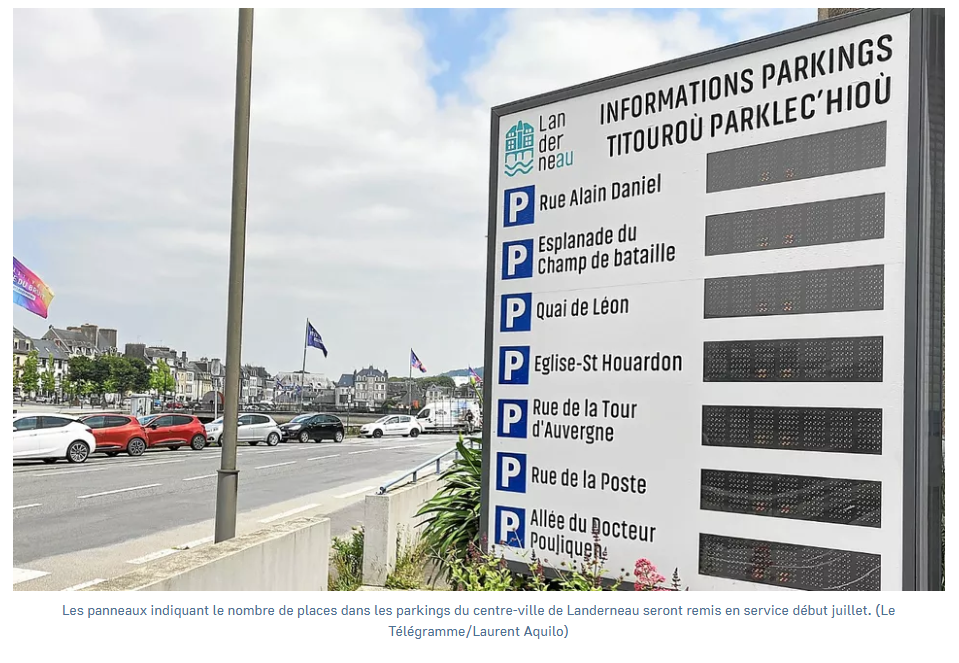
The solution was deployed in early 2022, with ground sensors in seven downtown parking lots and three digital variable message signs at city entrances (Quai de Cornouaille, rue de la Petite-Palud, rue Jacques-Cartier). But after just six months, everything came to a halt: the service provider, Parking Map, went into receivership.
Technical problems were piling up: sensors embedded in the pavement were coming loose, while others – exposed to the Elorn River – were falling victim to humidity. The panels no longer transmit anything. The town was left with an unusable infrastructure, and three years of negotiations and exchanges to try and relaunch the project.
2025: Cocoparks brings the system back into service in 2 months
Against this backdrop, the city called on Cocoparks for the technological solution, and on Citeos for the deployment.
The approach adopted is resolutely pragmatic: don’t start from scratch, capitalize on what already exists.
- The three existing panels are reconfigured to connect to the Cocoparks system.
- Ground sensors that are still functional are integrated via PLC.
- 19 new Cocospots – proprietary, weather-resistant aerial sensors screwed onto masts – complete the coverage of faulty or submersible areas.
On July 4, 2025, Landerneau’s connected car park was back in operation.
As Mayor Patrick Leclerc sums up:
“The quicker you find a place to park, the less traffic there is in town, and therefore the less CO₂ emissions. We’re boosting the attractiveness of the city center by making parking quick and easy.”
438 places guided in real time, a city back in control
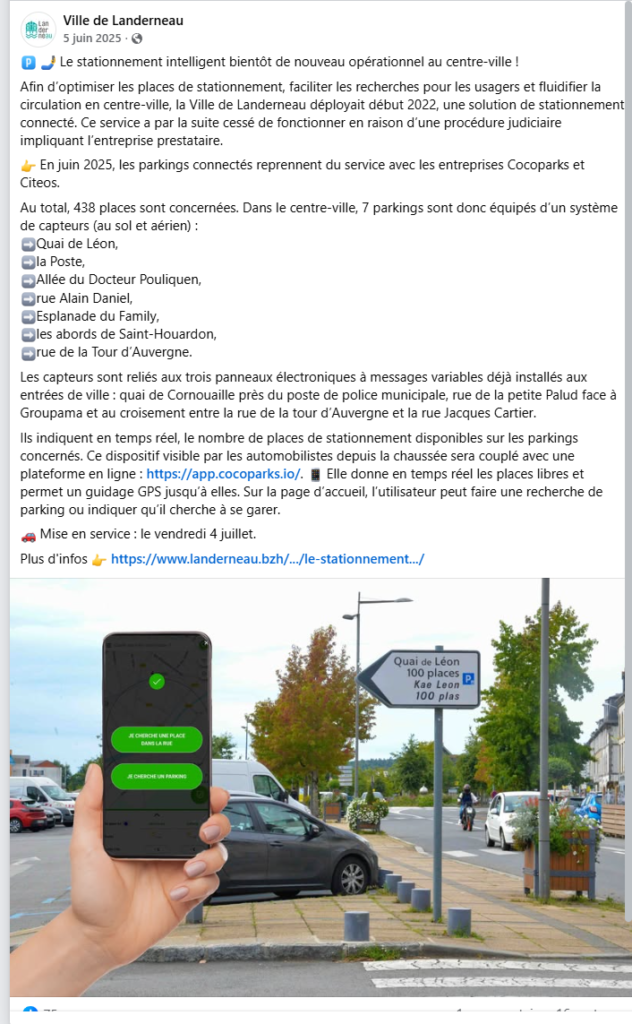
Today, 438 spaces in 8 zones are operated in real time: Quai de Léon, the Post Office parking lot, allée du Docteur Pouliquen, rue Alain Daniel, esplanade du Family, the area around Saint-Houardon and rue de la Tour d’Auvergne.
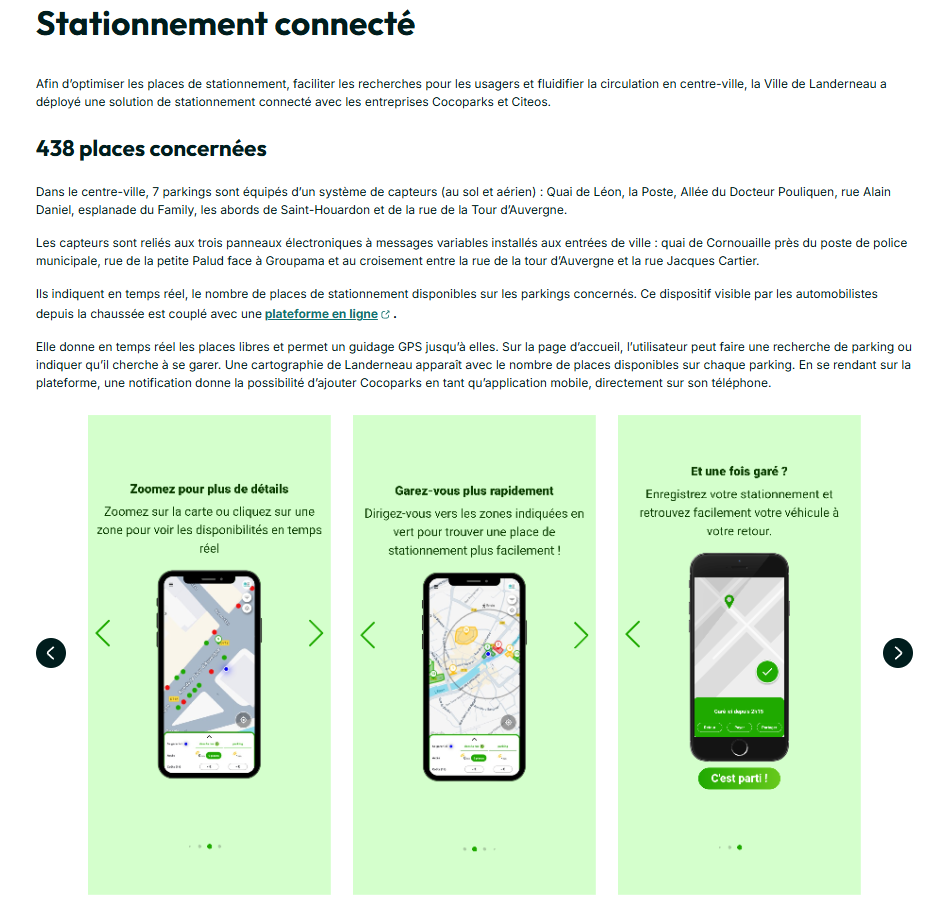
Availability is displayed live on 3 variable message signs at the town entrances. The municipal teams control the system via Cocopilot, the Cocoparks SaaS platform. And motorists can access real-time information – with integrated GPS guidance – via the Cocoparks mobile application.
A lesson for medium-sized towns
The Landerneau story illustrates an often overlooked reality: technology is not the problem, support is. A solution can fail not because it’s bad, but because the service provider isn’t up to the task over the long term.
Cocoparks has shown that it’s possible to take over a stalled project, adapt to the existing situation and get a town center up and running again quickly – without unnecessary extra costs. It’s precisely this frugality and reliability that make the solution accessible to medium-sized towns, where the big national operators won’t venture.
📰 Le Télégramme — “À Landerneau, la ville reconnecte son stationnement” · Ouest-France — “Le stationnement connecté reprend du service”